Showing posts with label picture book. Show all posts

Wednesday, December 8, 2010

Wild Tracks!

Have you ever been out for a walk in the woods and seen a set of animals tracks? Did you ever wonder what kind of creature might have made them? Well, if you happened to be carrying this book you might very well be able to identify them.

Wild Tracks, a non-fiction picture book written and illustrated by Jim Arnosky is an interesting and very informative book all about the various animal tracks you might stumble upon outside in the U.S. This handy little guide is filled with life-size drawings of all sorts of woodland creatures prints, so if you did happen to have this book with you, you could compare the tracks side by side. How cool is that?

For this book, Arnosky broke up his informational text into seven different types of tracks: deer, other hooved animals, bears, small animals, reptiles and birds, felines, and canines. For each section he includes a brief overview of the track family as well as labeled pencil drawings of the various animal prints. He also includes examples of tracks for animals running and walking with the average distances between each print.

The illustrations for this book are vibrant and colorful, which definitely lend a lot of spirit to the overall product. To really tie them into the concept of the book, Arnosky made sure that each animal in the painting also had their tracks displayed as you might see them in the wild.

Overall, I think students, especially upper elementary and above, would really enjoy this book and learn a lot from it, particularly with the life-size drawings. This is definitely a book you could use at your own home to figure out which little creature has been scampering across your flowers at night! You could even expand on this concept by having students make their own human tracks out of clay and displaying them around the room.
Clouds

One of my favorite things to do as a kid was to lay out in the yard and look at the clouds. I'd always imagine what it would be like to reach out and touch one.


From this non-fiction picture book titled Clouds, written by Anne Rockwell and illustrated by Frane Lessac, I was able to learn a whole lot more about the shape shifting cotton balls in the sky. This book, part of the first series of Let's-Read-And-Find-Out, provides detailed explanations of the many different types of clouds we can see in the sky. It describes how far up each cloud is located, what its name means, and what kind of weather you can expect from it.

I like that it doesn't tackle the more complex concepts of how clouds form and instead focuses on the idea that there are different types of clouds for different types of days. I think this would be a great book to read with younger elementary students, and could be used to introduce them to the science concept of weather. It even has a cloud experiment that they could do with an adult where they can make a cloud in a bottle. How cool would it be for them to be able to hold a cloud in their hand, just like what I'd dreamed about doing when I was a kid!


The illustrations in this book are very bright and eye catching, with plenty of little details for students to pick out. The fact that the pictures are so bold will help keep them focused on the different types of clouds and allow them to visualize each of the clouds in turn.

All in all, this is a great book to get younger elementary students excited and thinking about science, specifically the world around them.

Saturday, September 11, 2010

Fancy Nancy


Fancy Nancy, a picture book written by Jane O'Connor and illustrated by Robin Preiss Glasser, is about one little girl's efforts to teach her ordinary family how to be fancy.

Nancy “believes more is ALWAYS better, when it comes to being fancy”, but her family just doesn't understand. Lace-trimmed socks really do help you play soccer better!  Finally after many failed attempts of fancy intervention, she gets the idea to teach her family how to be fancy. With Nancy's help and unique accessories, they are transformed into an extraordinarily posh looking family wearing a plethora of bows, flowers, and feathers.

The illustrations (a fancy word for drawings) in this book are well done and include all the details a fancy person might want to see, including sparkles on the cover! Glasser does an excellent job of showcasing Nancy's creative spirit and glamorous sense of style on each page. To do this, Nancy is the most colorful character on each page, covered head to toe in all shades of fuchsia (Nancy's fancy way of saying purple), while her family and home are composed of simple greys and browns.
The writing style of O'Connor is also wonderfully well done and provides a clear window into Nancy's ornate world, while hitting home with a sweet, simple, family message. As the story progresses O'Connor uses many fancy words to replace the plain ones, and by doing so, breathes more life into Nancy's ornate personality. This use of vocabulary also serves as a great segue into lessons about synonyms and the many wonderful adjectives out there.

Fancy Nancy is a wonderful story for anyone, children and adults alike, needing some fashion inspiration without adding any unnecessary princess ideals, and is just one part of the popular series of Fancy Nancy picture books. So put on your laciest socks, nestle into your coziest seat, and get a little fancy!

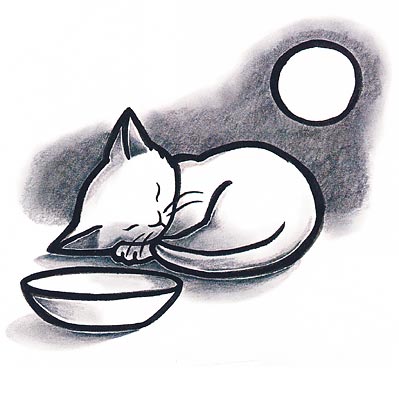
Kitten's First Full Moon

Have you ever wanted to reach out and touch the moon or stars? In Kitten's First Full Moon, a Caldecott Medal winner, by Kevin Henkes, a persistant little kitten tries to do just that.

     This picture book is about an inquisitive kitten's first experience seeing a full moon. The story opens with Kitten sitting on her front porch enjoying the night. Through a group of fluttering fireflies, she sees a purrfectly deliciousl bowl of milk hanging in the sky, and tries with all her kitten might to taste it, catch it, and drink it! Will this unlucky kitten ever get her little bowl of milk?

     The illustrations for this picture book contain no color, but instead use muted blacks and whites to envelope the reader in the story's own “colorful” nighttime atmosphere. The simple drawings also complimented the tenacious kitten's story well, with the moon always being just out of reach at the top corner of the book. Once the story is over it will leave you peering outside your window for a wayward kitten on her quest for a nighttime snack.
   

One unique way to utilize this story at home or in a classroom is as a way to introduce readers to the different phases of the moon and what objects each phase resembles to them. Readers could even write their own stories of what they think other animals do on nights with a full moon.

Kevin Henkes is an experienced children's book author, having published his first book at the age of 21. He now has over 30 books under his belt and several awards to boot. His inspiration for this story actually came from a line in a previous book idea that didn't make the cut. Lucky for us, Henkes expanded on this one line to create a wonderful story about Kitten's first full moon.


      Other wonderful stories by Kevin Henkes include the Mouse book series, Old Bear, and A Good Day.

Centipede's 100 Shoes

In Centipede's 100 Shoes, also known as One Hundred Shoes, written and illustrated by Tony Ross, a young centipede decides he needs new shoes to protect his little bug feet. 

As the story progresses the little centipede purchases 100 shoes, because as he states “I'm a centipede, which means a hundred feet.” Once home, however, he discovers that most centipede's don't have 100 feet. Though still excited about finally having shoes, the little bug finds that his new shoes hurt his feet, and so is given socks to wear as well. By the end of the story the little centipede is tired of putting on and taking off 42 socks and shoes everyday. But, what is a centipede to do with 100 extra shoes?

The illustrations by Ross in this picture book are cute and created mainly through water colors. The expressions on the little centipede's face do well at conveying his excitement and frustration, and great care was taken in creating both the background and centipede. There was even a cute little love story going on in the back ground for the alert reader to watch unfold.

This book would make a great introduction to a math or science unit involving bugs for younger children, as it does include a bug fact and number counting at the very end. A reader could extend this idea in math by coming up with different bug combinations that could use up all of the socks and shoes with no cold feet left out. So what are you waiting for? Slip on your socks, tie up your shoes and head out to your local library! You don't have 42 feet!

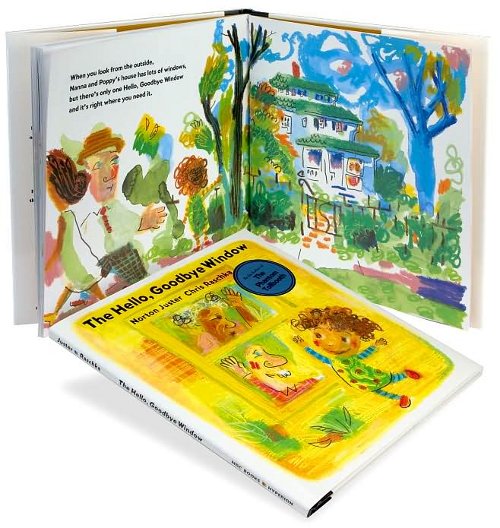
The Hello, Goodbye Window

Is there a special place in your home where you feel especially connected with your family? For one little girl that place is a window at her grandparents' house; their Hello, Goodbye Window.

In this Caldecott award winning picture book, The Hello, Goodbye Window, written by Norton Juster and illustrated by Chris Raschka, a little girl describes all the magical reasons why this one ordinary window is so special. As she states at the start of the story this special window “looks like a regular window, but it's not.” When she is dropped off at her grandparents' house, she continues her little ritual of peeking into the special window and greeting her Nanny and Poppy. As the story progresses she tells of the many cozy family events that transpire in their house and relates them back to the magic window.

The illustrations created by Chris Raschka are playful and drawn through the eyes of a child. Each page is filled with splashes of color and highlight all the fun the little girl has with her grandparents. Raschka used multiple techniques when creating these illustrations, which encourages the readers eyes to search the page for the different details. The little stories depicted in the writing evoke sweet family memories and would be a great addition to any family's storybook collection.

One way to utilize this book in the classroom is as a writing prompt for students to creatively describe their own special place or people waiting for them at home. This could be in the form of a journal or their own book. They could even draw their own Hello Goodbye Windows using their own memories to personalize it.

                                   Do you have a special place filled with wonderful memories? I know I do.

Other stories created by Norton Juster and Chris Raschka include a sequel to this warm and fuzzy picture book called Sourpuss and Sweetypie.

Friday, September 10, 2010

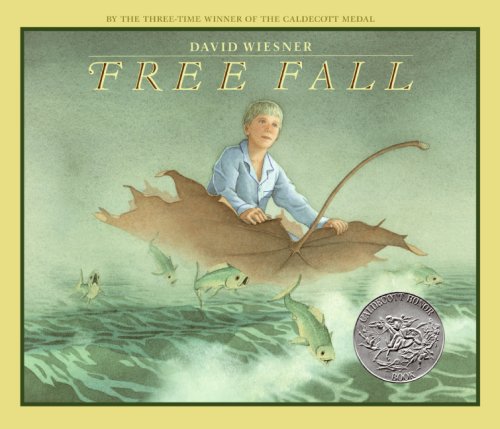
Free Fall


Have you ever had a dream that was so wondrous and detailed that you wished you could write it all down and share it with everyone? If your answer is “yes”, then you'll enjoy this book, Free Fall, by David Wiesner. This picture book, and winner of a Caldecott Honor Award, fits its genre to a T from cover to cover, with the only words to the story being a poem on the inside jacket. 

The story focuses on a peacefully slumbering boy, who has drifted off to sleep during a midnight reading session. As he sleeps, his bedroom seamlessly shifts from reality to his dream world, where he steps onto a life sized chessboard and is greeted by the king and queen of the land. From there, as he travels through the pages, he encounters amazingly detailed scenes and characters, including a dragon, before gliding into bed from his fantastic dream. 

The creator and illustrator, David Wiesner, does a remarkable job of transitioning from scene to scene with each exquisitely detailed page, and uses the entire page to demonstrate his dreamworld. At the start of the story, Wiesner utilizes the white margin border to symbolize the rigid existence of the real world. As the reader's eyes wander from one page to the next, reality melts into a dreamland between them and expands across to the very edge of the next page with no margin or border to stop it. Each detail on one page slowly transforms on the next and flows to the other side to continue the next chapter of the story. Even the color pallet chosen for this story was somewhat muted, and the drawings themselves were drawn in a slightly hazy way much like a dream.

As an added bonus to this artfully illustrated book, readers have the ability to create their own written story to go along with the illustrations, and expand upon the author's dreamworld in their own imagination. Anyone care to dream a little?

Other award winning stories written by David Wiesner include Tuesday, The Three Pigs, and his most recent publication Flotsam.